SANKEY (ST HELENS) Canal
The Act authorising the Sankey Brook Navigation was passed in 1755. Although it claimed to improve the existing brook, a loophole in the law allowed engineers to cut an entirely new waterway — the Sankey Canal. By 1757, it was carrying coal, making it England’s first canal of the Industrial Revolution and the country’s first modern canal.
The canal’s engineer, Henry Berry, Liverpool’s Second Dock Engineer, had previously worked with Thomas Steers on the Newry Canal in Northern Ireland — the first canal in the British Isles.
Built to transport coal to Liverpool’s growing chemical industries, the Sankey spurred rapid industrial expansion in St Helens, Earlestown, and Widnes, transforming small villages into thriving industrial centres.
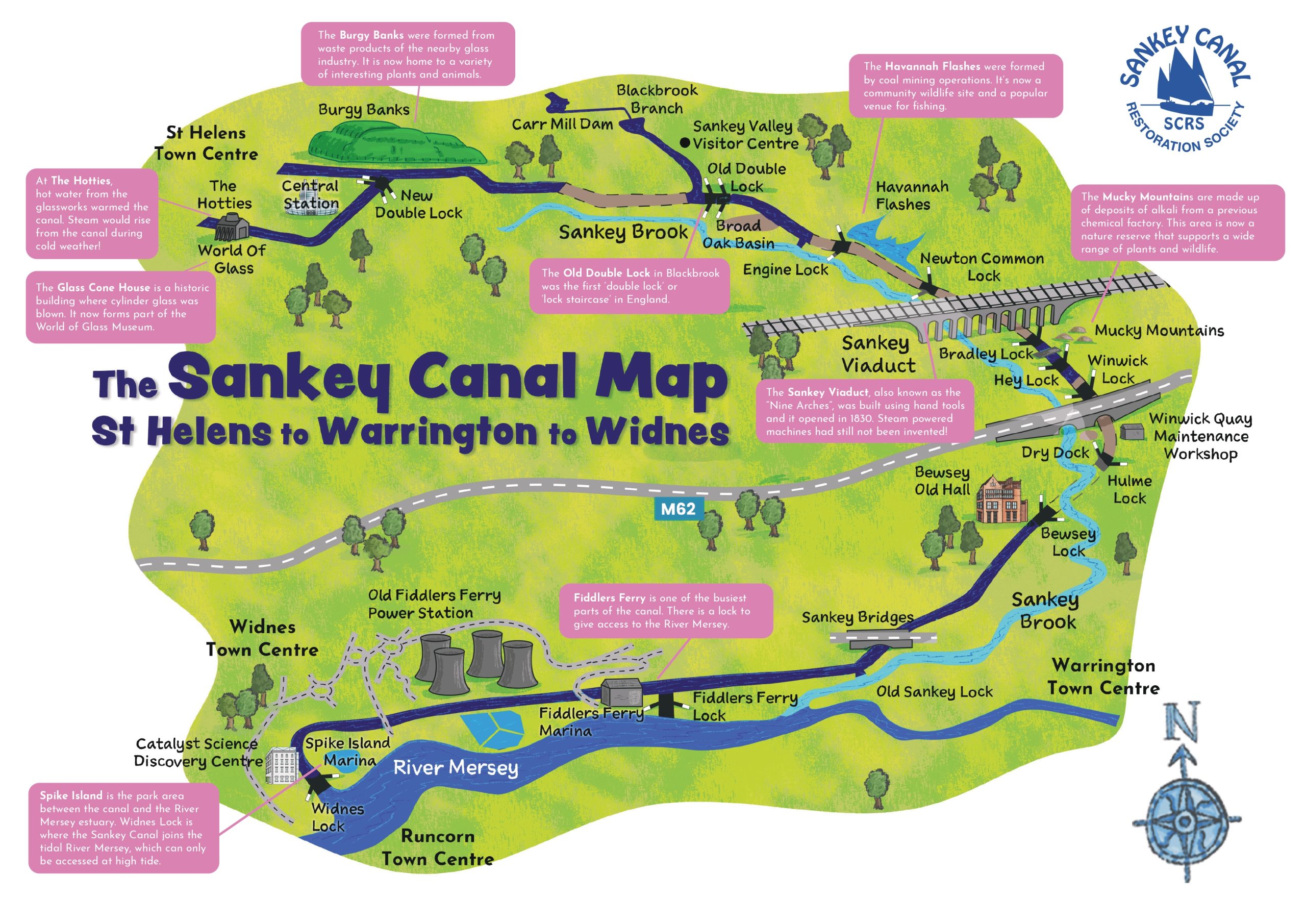
Designed for Mersey flats (local sailing barges), the canal featured swing bridges to allow their masts to pass. When railways arrived, similar crossings were needed — except at Earlestown, where George Stephenson’s impressive viaduct for the Liverpool–Manchester Railway provided 70 feet of clearance for the boats.
The Sankey also saw England’s first double, or “staircase,” locks built at Broad Oak, St Helens, with a second set later added at Parr.
While originally carrying coal to the Mersey, its final cargo was raw sugar from Liverpool to the Sankey Sugar Works at Earlestown. When the sugar trade ended in 1959, the canal closed in 1963, though much of it remained in water up to the centre of St Helens.
The Sankey’s early success, followed by the Bridgewater Canal, triggered Britain’s “canal-building mania.” Several extensions were proposed — linking to the Leeds & Liverpool Canal, the Bridgewater, and the Trent and Mersey via a Mersey aqueduct at Runcorn — but only three were completed:
-
1762: to Fiddlers Ferry for improved access to the River Mersey
-
1775: extended into St Helens
-
1832: extended to Widnes to meet railway competition
In 1845, the St Helens Railway Company acquired the canal, renaming it the St Helens Canal and Railway Company.
For maps, history, and a virtual tour, visit Pennine Waterways.
Restoration work on the canal predates the formation of the Sankey Canal Restoration Society (SCRS) which was founded in 1985.
The two locks into the River Mersey were restored in the early 1980’s to form marinas for sea-going/estuary pleasure boats: